Gardening


TrueKnee
Your knee,resurfaced to your own anatomy.
TrueKnee is a new surgical technique that aims to resurface a worn knee back to its native anatomy: the shape, alignment and motion you were born with, rather than a standard target. Understand what that means for your knee, then meet a surgeon who offers it.
See how resurfacing works ↓EXPLORE YOUR ANATOMY
What makes your knee yours.
TrueKnee surgeons start by understanding your anatomy: the shape of your bones, the surfaces of your joint, and the ligaments that guide its movement.
Preparing your knee…
THE WHOLE PICTUREThe whole knee
Drag to turn · Hover to discover · Click or tap to isolate
A plan for your knee.
Traditional Replacementvs.TrueKnee Resurfacing
A standard alignment—or an alignment shaped by you.
Traditional mechanical alignment follows a common target. TrueKnee Resurfacing starts with your own anatomy.
See how it worksAnatomy. Resurfacing. Lifestyle.
Your knee is one of one.
A natural range
Every knee has its own alignment
Some legs naturally bow outward. Others are straighter or angle inward.
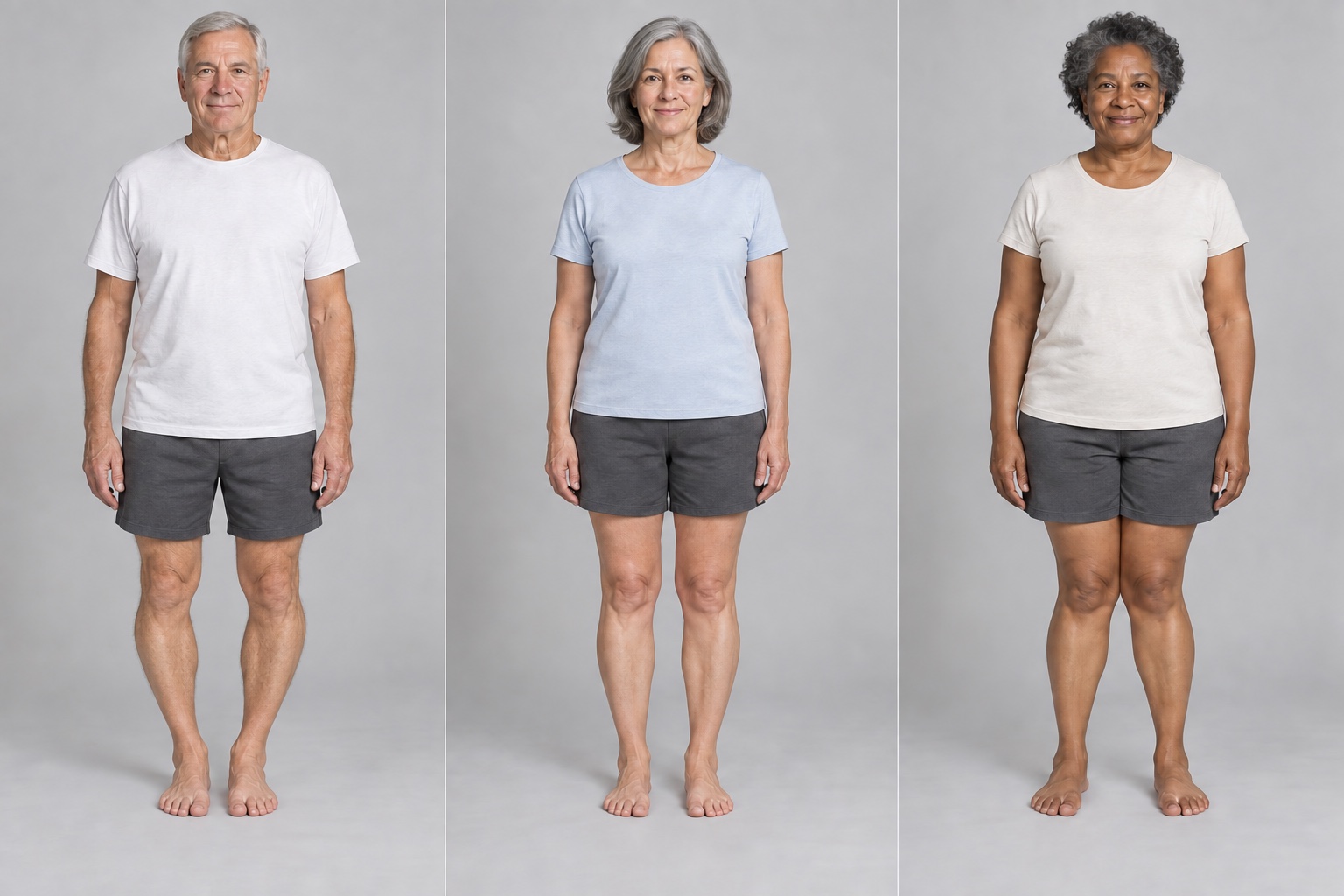
Bowed outwardStraighterAngled inward
AI-generated illustrations of leg alignment. Not patient photographs or measurements.
See the difference
Designed around
your original anatomy.
One knee. Two approaches. Choose one to see what changes.
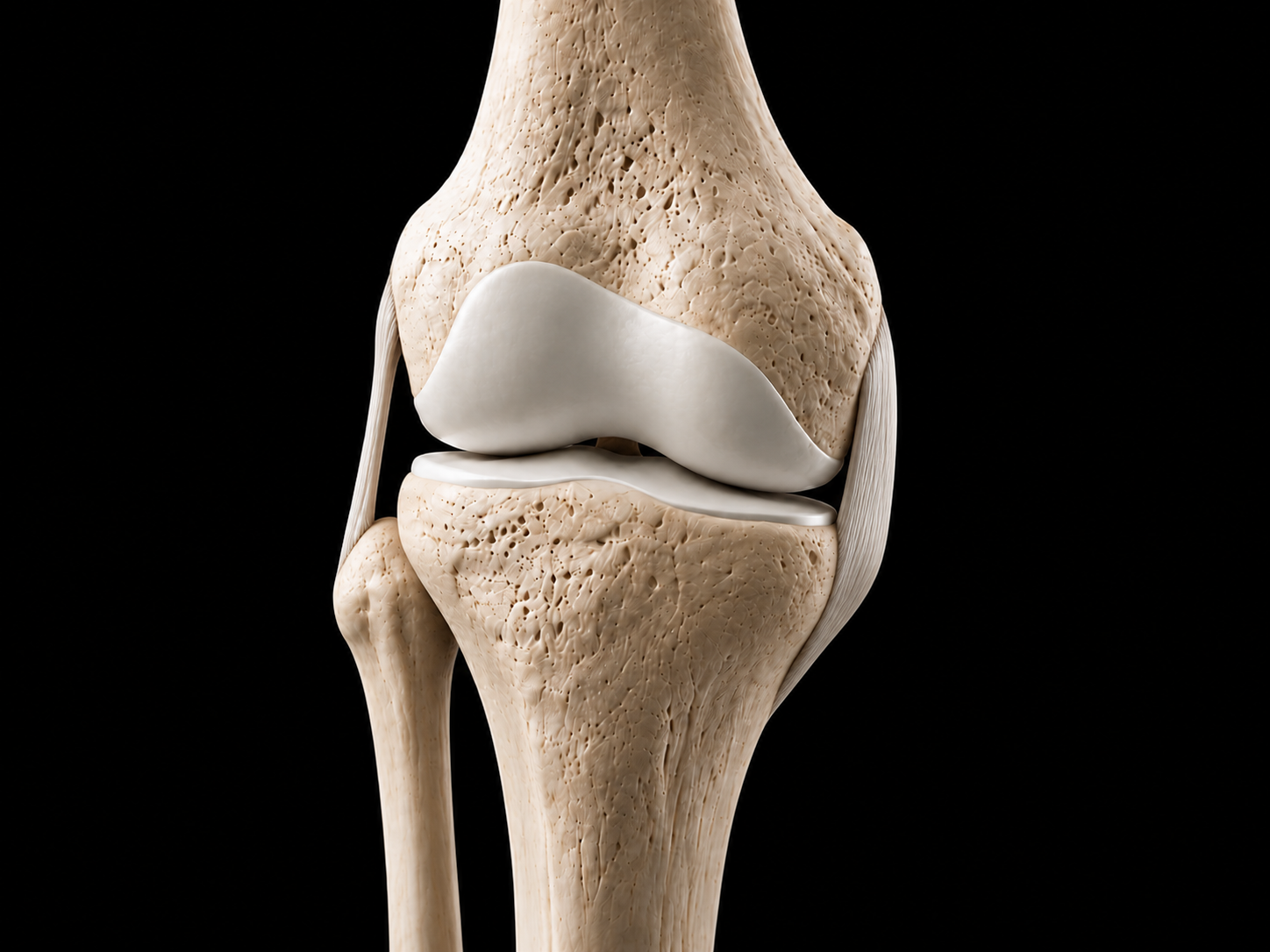
Original joint lineYour anatomy
Illustrative alignment guides on an existing knee model, not a surgical simulation or predicted result. Traditional mechanical alignment targets a straight hip–knee–ankle axis; other knee replacement approaches can also personalize alignment. About alignment approaches ↗
01
Every knee has its own joint angles
Every knee has its own alignment and joint line.
Loading knee anatomy…
Joint angleKnee alignment
Neutral knee alignment and Neutral joint angle.
Illustrative anatomy. Based on CPAK ↗ · Native knee variation ↗
02
Your unique femur shape.
Your thighbone ends in two rounded surfaces. Their size, shape, and curves are unique to you.
Your femur also contributes to the angle of your joint.
03
Your unique tibia shape.
The top of your shinbone (tibia) also has its own unique shape. Its surface and natural angle vary from person to person.
04
Your Natural Motion
A balance to check through active motion.
Your knee bends, glides and rotates. The outside moves farther backward than the inside as your knee bends. The inside of your knee stays more stable throughout motion.
Preparing the knee…
0°
Illustrative 0–120° motion based on the phased pattern described by Iwaki et al. (2000). Individual knees and activities vary. Explore the evidence ↗
07
Three routes to the joint
How we reach your knee.
How we reconstruct it.
Different routes can lead to the same reconstruction. The route alone doesn’t tell you how the implants will be positioned.
Beneath the inner quadriceps muscle, preserving the muscle and tendon
Loading anatomy…
Front view · surgical approach
01 / EXPOSURE
How we reach your knee.
The approach is the route your surgeon takes through or around the tissues.
Different routes.
The same restoration goal.
Illustrative anatomical reference, not patient-specific planning or a prediction of motion. Resections are simplified; anatomy, exposure and ligament balance require surgical assessment.
What do the studies show?
Early recovery. Subvastus and midvastus approaches may offer modest benefits in the first few weeks, such as less pain, earlier muscle control, or more knee movement. Individual recovery varies. [1, 2, 3]
Later recovery. Early differences tend to fade. Studies have not consistently shown better longer-term function, movement, complication rates, or need for further surgery. [1, 3, 4]
The trade-off. Some approaches can make the joint harder to see, especially in larger or stiffer knees or after previous surgery. The approach should never compromise accurate implant placement. [1, 5]
The best approach allows your surgeon to safely and accurately reconstruct your knee.
Explore the knee approaches reference library · 802 articles →Evidence from total knee replacement studies.
Published research
Evidence
Studies examine activity, early recovery, alignment, and surgical accuracy. Each answers a different question.
- Activities after surgery · Lester D, et al ↗
- Early recovery · Berstock JR, et al ↗
- Implant alignment · Gibbons JP, et al ↗
- Anatomic landmarks · Parratte S, et al ↗
These studies do not establish that TrueKnee Resurfacing as a complete technique delivers faster recovery or better outcomes than other knee replacements.
Read what this means for you ↗YOUR NEXT STEP
Meet a surgeon
who offers TrueKnee.
TrueKnee is performed by surgeons trained in the technique. Search by name or location, and use the TrueKnee filter to see the surgeons who offer it. A consultation is where your anatomy, your goals and the plan come together.
Find a TrueKnee surgeonBring your questions. Your surgeon decides with you whether TrueKnee fits your knee.
Your surgeon. Your choice.
Find a surgeon.
Search by name, practice, city, state, or ZIP.
The life you love
TrueKnee.
Life in motion.
A knee resurfaced to your own anatomy is designed to move the way your knee always did, so the activities you love are the goal of the plan, not an afterthought. Results vary, and your surgeon decides with you.
Pickleball
Back on the court.
Cycling
Out for a ride.
Golf
Back to your swing.
Lifestyle footage, not patient results. Discuss your activity goals and the timing of your return with your surgeon. Cycling scene is AI-generated.
IS TRUEKNEE FOR ME?
Two tools to understand
whether a TrueKnee fits you.
Know Your Tilt shows the alignment a TrueKnee would be planned around. The Fit Score weighs your symptoms, daily life and goals, and tells you what to bring to the conversation. Neither is a diagnosis; both prepare you for one.
The Voyage
The path to a TrueKnee.
The Voyage is the process of getting a TrueKnee: deciding whether it is right for you, preparing for surgery, and recovering with your progress in one place. Start it before you have a surgeon or a date.
Your Voyage comes first. Personal Guide support is an optional service to discuss with a connected practice. The team, services and cost are confirmed before you choose to enroll.
Explore optional personal supportStart your VoyageDeciding.
Understand your anatomy and your options, get your Fit Score, and bring the right questions to a TrueKnee surgeon.
Preparing.
Get ready for your TrueKnee: health, home support, equipment and the instructions from your surgical team, in one checklist.
Recovering.
Check in on your pain, movement and everyday life as your knee comes back, and keep your progress in one place for every follow-up.
Use Voyage alongside the instructions from your surgical team. Your check-ins describe your progress; they do not guarantee a result.
08
A better conversation
Common questions.
What is TrueKnee?
TrueKnee is a surgical technique for resurfacing a knee worn by arthritis. Instead of cutting the bone to fit a standard alignment target, the surgeon plans the implants around your own anatomy: your joint line, your alignment and the way your knee moves. The aim is a knee that feels like yours. It is performed by surgeons trained in the technique, and your surgeon decides with you whether it fits your knee.
Will my knee feel natural and let me return to the activities I enjoy?
TrueKnee puts your goals at the center of the conversation. Resurfacing aims to rebuild worn joint surfaces. How your knee feels and which activities you can return to depend on your health, surgery, and recovery. Results vary. Every knee replacement carries risks, including infection, blood clots, stiffness and the possibility of further surgery.
Is resurfacing a knee replacement?
Yes. Resurfacing describes replacing damaged joint surfaces with implants. TrueKnee is the name of the approach; TrueKnee Resurfacing is the surgical technique. Ask your surgeon which surfaces will be treated and which operation is right for you.
Do you have to cut bone?
Yes. Your surgeon removes damaged cartilage and some underlying bone, prepares the surfaces, and secures the implants. The amount and the plan depend on your knee and the chosen procedure.
Will every knee be positioned the same way?
No single plan fits every person. Your surgeon considers your bone shape, supporting tissues, and overall health when choosing how to position the implants. Ask why that plan fits your knee.
How is the surgical approach different from resurfacing?
The approach is how your surgeon reaches the knee. Reconstruction is how the damaged surfaces are replaced and the implants positioned. Different approaches can be used for the same reconstruction.
How does Jiffy Knee relate to surgical approach?
Jiffy Knee is a branded knee replacement offering. Its website describes an approach that preserves muscles and tendons by moving them aside to reach the joint.
When discussing surgery with your surgeon, ask two separate questions: How will you reach my knee? How will you reconstruct its joint surfaces and alignment?
Read Jiffy Knee’s description.
This website is not affiliated with, sponsored by, or endorsed by Jiffy Knee. The name is used solely to identify and discuss that offering.
YOUR NEXT STEP
Start your Voyage.
Save your progress, organize your questions and keep your next step in view. Your Voyage stays with you as your plans change.